
Sticky collisions

Sticky collisions

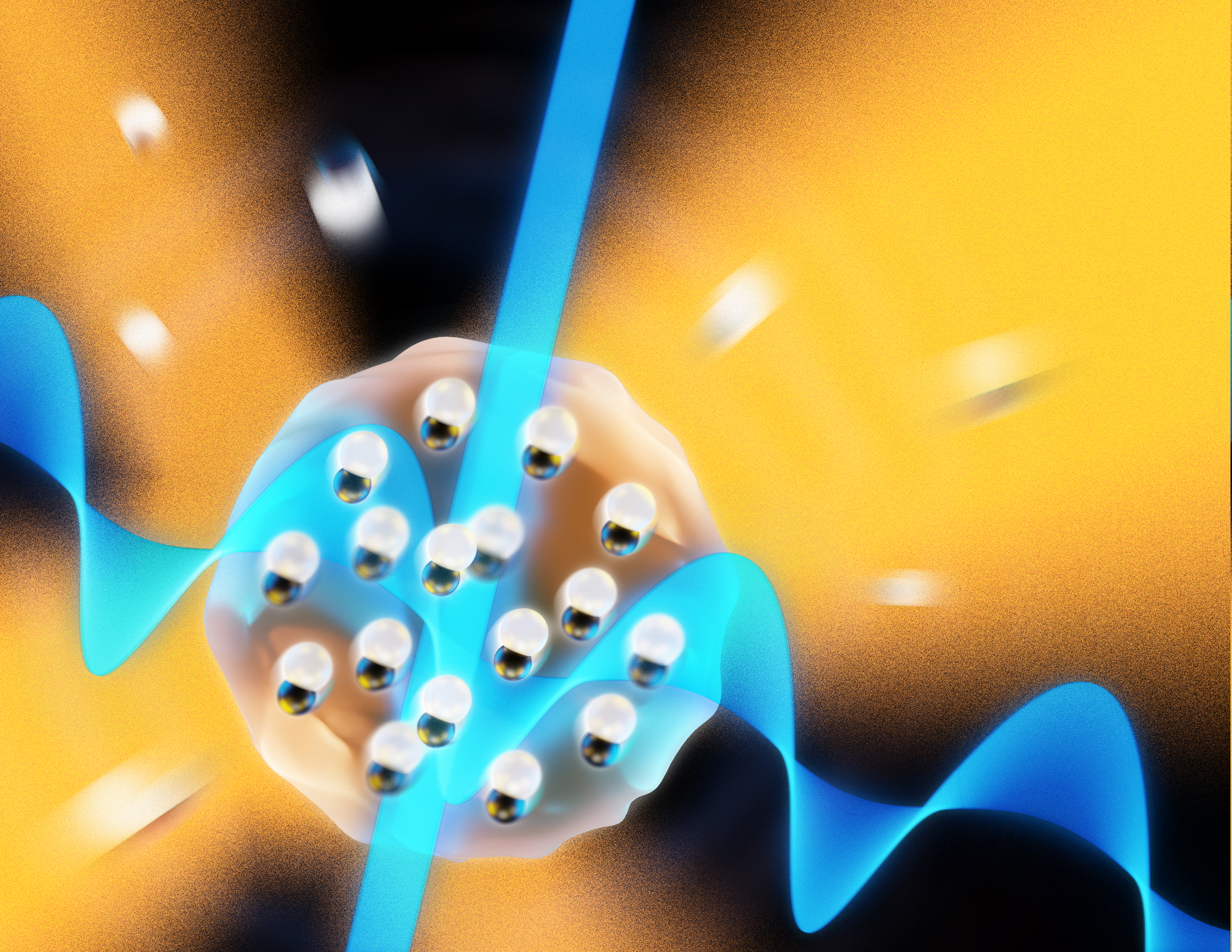
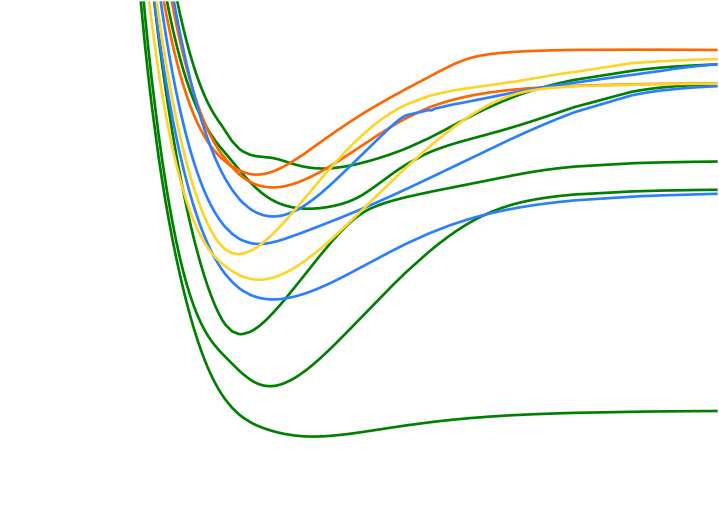
Ultracold molecules can be stable against chemical reactions, yet experiments have found that they can still be lost when they collide. What causes this loss? One intriguing possibility is that two molecules undergo "sticky collisions"; At ultracold temperatures they can form unusually long-lived collision complexes, which perhaps mediate the loss. This raises the question what happens microscopically during these collisions and how the complex is ultimately lost.

We develop theory to study these long-lived collision complexes and explore their possible role by exotic processes such as photo-excitation by the trapping laser. Subsequent experiments have observed sticking and trap-photo-chemistry in semi-quantitative agreement with our predictions. Other experimental observations remain unexplained, and the microscopic origin of collisional loss is not yet fully understood. Understanding what happens when ultracold molecules collide - and how this loss can be controlled - remains an active research direction.

Related publications

Figure from publication
Photoinduced Two-Body Loss of Ultracold Molecules
Arthur Christianen, Martin W Zwierlein, Gerrit C Groenenboom, Tijs Karman

Theoretical prediction of photo-excitation of ultracold collision complexes in sticky collisions.

Physical Review Letters (2019)
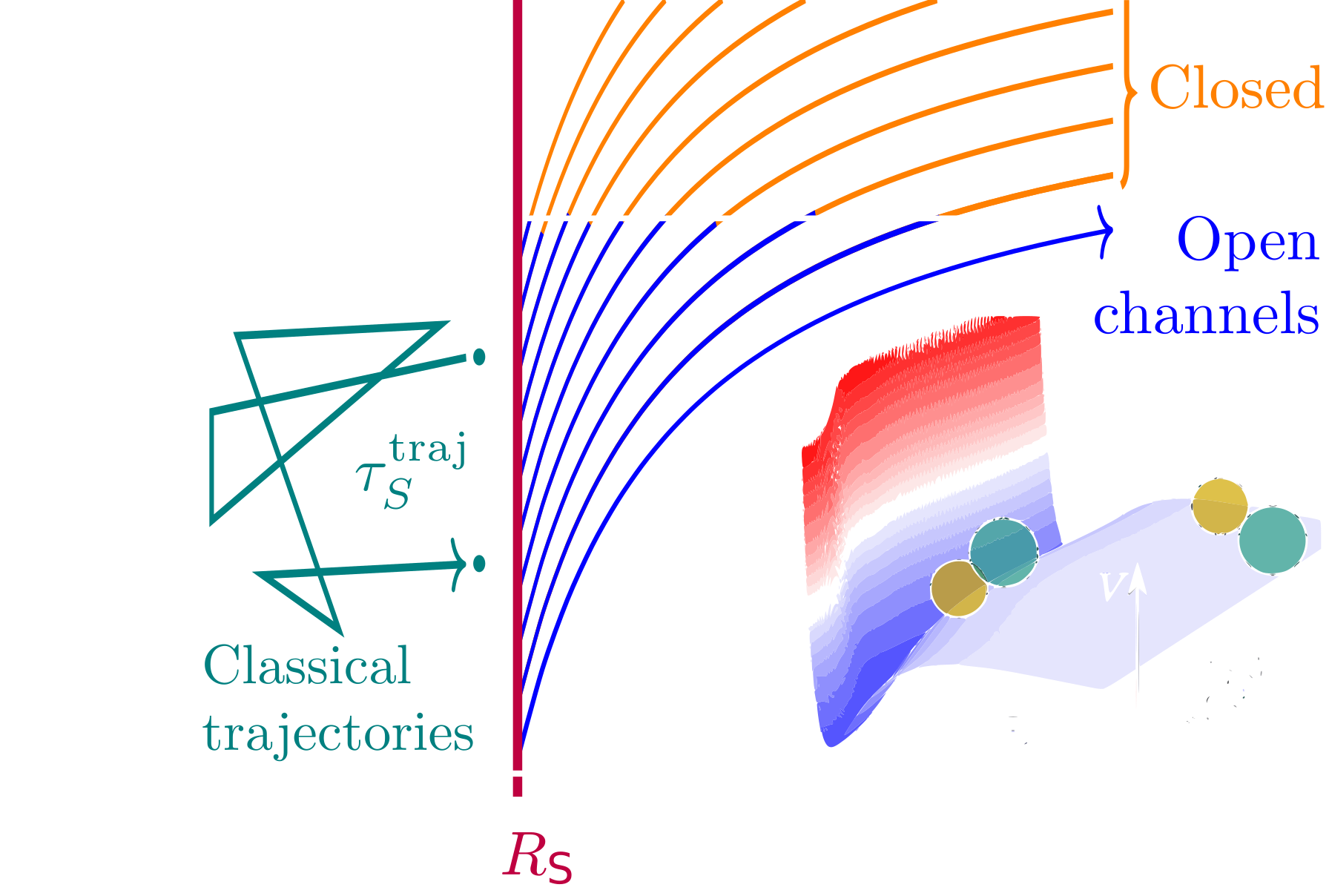
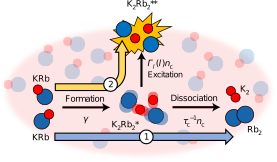
Figure from publication
Symmetry breaking in sticky collisions between ultracold molecules
Marijn P Man, Gerrit C Groenenboom, Tijs Karman

Breaking of rotational symmetry by external fields leads to longer sticking times.

Physical Review Letters (2022)
Figure from publication
Photo-excitation of long-lived transient intermediates in ultracold reactions
Yu Liu, Ming-Guang Hu, Matthew A Nichols, David D Grimes, Tijs Karman, Hua Guo, Kang-Kuen Ni

Experimental demonstration of sticking and photo-excitation of ultracold collision complexes by the trapping laser, predicted theoretically.

Nature Physics (2020)

← Back to homepage